
A football ground is more than a pitch surrounded by stands. It is an arrangement of streets, entrances, sightlines and routines that supporters learn through repeated visits. The turnstile used every week, the place where friends met and the route towards the terrace could become as familiar as the match itself.
When a stadium closes, much of that experience disappears. Some sites are demolished completely, while others are redeveloped with only fragments of their footballing architecture retained. Photographs provide the clearest visual evidence, but football programmes preserve something broader: the way clubs presented their grounds and how supporters used them.
From Highbury and Maine Road to Roker Park, the Baseball Ground and beyond, these publications offer paper routes back into lost matchdays.
Programmes as Records of Changing Architecture
Grounds changed constantly, even before their final closure. Terraces gained roofs, wooden stands were replaced, floodlights arrived and advertising boards multiplied. Later, safety requirements transformed many traditional enclosures into all-seater stadiums.
Programme photographs capture these developments from angles rarely chosen for formal architectural records. A player portrait might show a stand in the background, while a reserve-team report includes an image of a half-empty terrace. Seating plans, safety notices and redevelopment drawings provide further evidence.
Collecting issues from different decades allows one ground to be followed through its physical evolution. Changes to entrances, stand names and capacity can all be traced through the printed material.
This makes programmes valuable beyond their connection to a fixture. They show how stadiums were adapted to meet changing expectations while retaining the identity supporters recognised.
Highbury and Its Distinctive Character
Arsenal’s Highbury became one of English football’s most recognisable grounds. Its Art Deco façades, close relationship with the surrounding streets and carefully designed stands gave it a character very different from that of a modern bowl stadium.
Programmes frequently used the ground as part of the club’s visual identity. Covers, photographs and historical features celebrated its architecture, while diagrams helped visitors understand its compact layout.
Older editions record standing areas and changing arrangements long before Highbury’s final all-seater years. Later issues reflect the growing pressure for greater capacity and the eventual move to a new stadium.
The programmes from the final season naturally carry special emotional weight. Commemorative features revisited famous matches, players and parts of the ground that had shaped generations of Arsenal support. Although elements of the listed stands were incorporated into residential redevelopment, the matchday stadium itself disappeared.
A run of Highbury issues can therefore document both an architectural landmark and the rituals built around it.
Maine Road and a Ground of Contrasts
Manchester City’s Maine Road was known for its enormous scale in earlier decades, distinctive stands and changing appearance. Built within the streets of Moss Side, it became deeply connected with the experience of approaching a major urban football ground.
Programmes preserve views from before later redevelopment altered the stadium. Crowd photographs show vast terraces, while cover designs and aerial images reveal how the stands related to one another.
Editorial notes also record practical aspects of attending: admission arrangements, transport advice, ticket queues and instructions for major fixtures. These details help reconstruct a matchday beyond the pitch.
As City prepared to leave, programmes increasingly reflected on Maine Road’s greatest occasions and the supporters who had filled it. Final-season issues became intentional souvenirs of a home about to vanish.
The site was subsequently redeveloped, making programmes, tickets and personal photographs essential evidence of what once stood there.
Highbury and Maine Road in the collection
-

Arsenal v Man Utd 01.02.1958 - Scores in a 5-4 thriller at Highbury
-
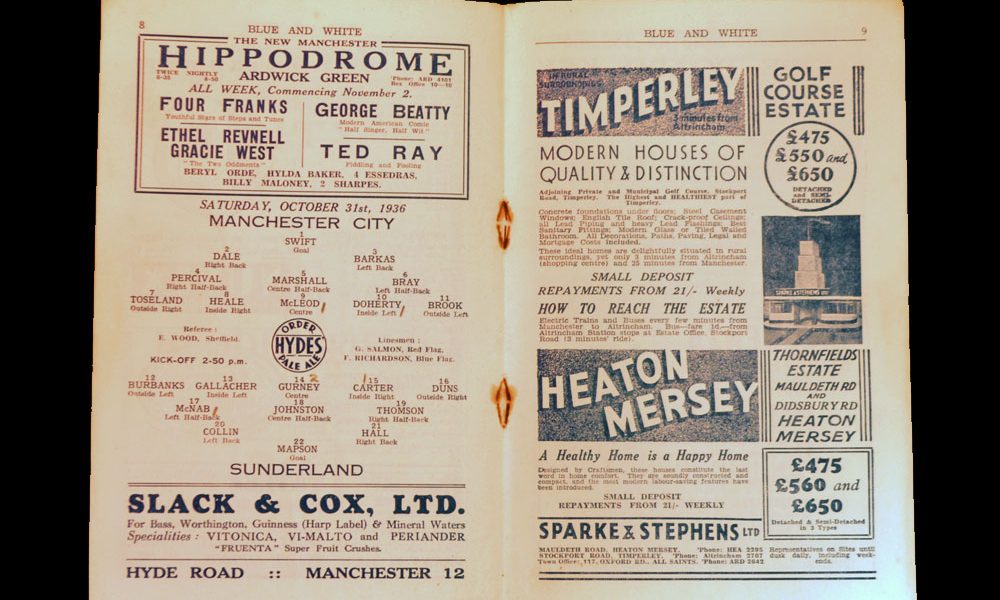
Man City v Sunderland 31.10.1936
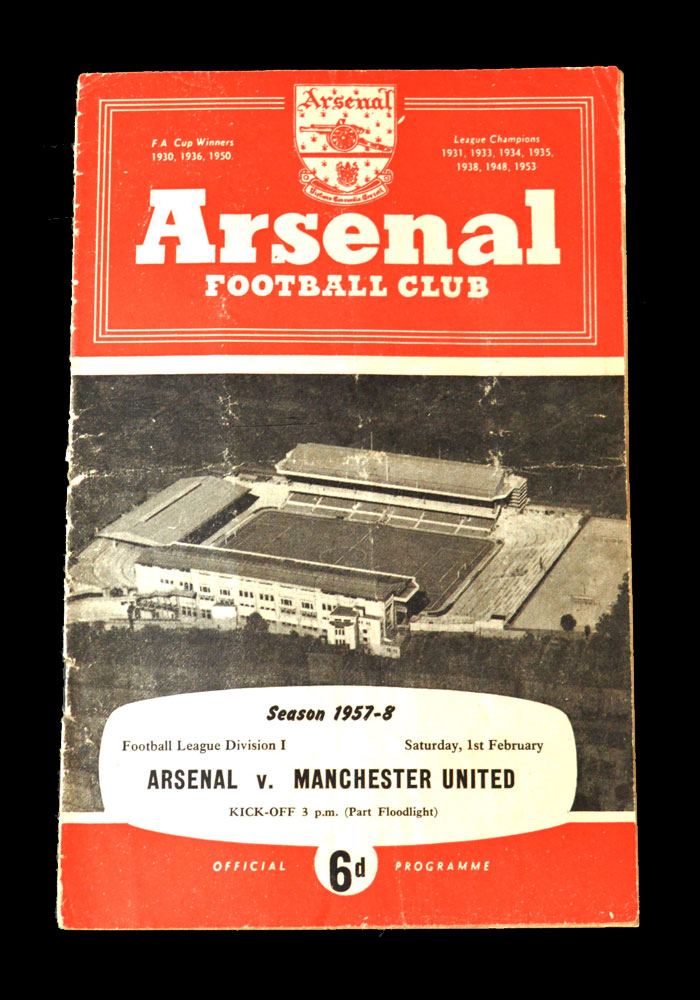
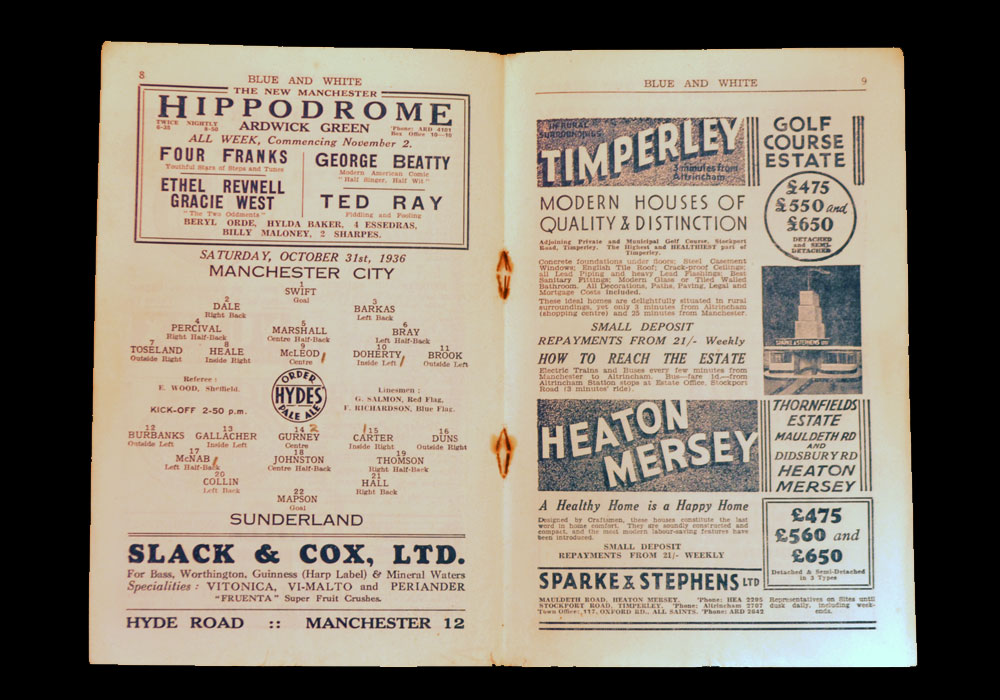
The archive identifies these programmes as Arsenal v Manchester United, 1 February 1958, and Manchester City v Sunderland, 31 October 1936. They provide examples from the Highbury and Maine Road eras.
Roker Park and the Sunderland Matchday
Roker Park represented Sunderland for nearly a century. Its terraces, low roofs and intensely local setting created an atmosphere remembered long after the club moved to the Stadium of Light.
Old issues show how supporters were distributed around famous sections of the ground and how facilities changed across the decades. Advertisements for local shops and public houses recreate the commercial geography surrounding the stadium.
The move brought greater capacity and modern facilities, but programmes from the closing years reveal the emotional difficulty of leaving. Features celebrated memorable goals, cup runs and players whose identities had become inseparable from Roker Park.
Final-match publications are popular, yet earlier ordinary fixtures can communicate the ground’s character just as powerfully. A winter league issue marked by rain and terrace use may feel closer to the weekly experience than a polished farewell edition.
The Baseball Ground and the Tightest of Settings
Derby County’s Baseball Ground was famous for its close stands and challenging pitch conditions. Surrounded by houses and industrial streets, it offered the enclosed atmosphere associated with traditional English grounds.
Programmes from Derby’s successful periods connect famous teams with this distinctive setting. Action photographs often show supporters immediately behind the touchline, reinforcing the sense that the crowd sat almost on top of the play.
Ground-development features reveal attempts to improve facilities within a restricted site. Advertising and travel information also place the stadium firmly within its local environment.
After the club moved to Pride Park, the Baseball Ground ceased to host senior football and was eventually demolished. Programmes now preserve not only major championship matches but ordinary days when the stadium still functioned as a familiar neighbourhood institution.
Upton Park, Ayresome Park and White Hart Lane
Many other lost grounds can be explored through their publications. West Ham United’s Upton Park, officially the Boleyn Ground, appeared in countless programme photographs showing tightly packed stands and an unmistakable East London setting.
Middlesbrough’s Ayresome Park issues document a ground connected with industrial Teesside and international football during the 1966 World Cup. Later editions trace the club’s difficult years and eventual departure for the Riverside Stadium.
Tottenham Hotspur’s old White Hart Lane was demolished to make way for a completely new stadium on and around the same site. Programmes from its final campaign carefully celebrated individual stands, famous European nights and the relationship between the ground and generations of supporters.
These examples show that a lost stadium does not always disappear because a club leaves the area. Sometimes the address remains associated with football while the structures and physical experience change completely.
The Baseball Ground and Ayresome Park
-
Derby v Leicester 10.04.1946
-
Midlesbrough v Luton 30.04.1995 (Last match at Ayresome)


Archive examples: Derby v Leicester, 10 April 1946, and Middlesbrough v Luton, 30 April 1995. The Middlesbrough issue is catalogued on the site as a last-match-at-Ayresome programme.
Match-Going Rituals Between the Pages
Architecture is only part of a ground’s story. Programmes also preserve the routines surrounding attendance.
Transport notices explain which buses or trains supporters used. Maps identify turnstiles and entrances, while advertisements point towards cafés, pubs and shops visited before or after the match. Ticket information shows the differences between standing and sitting, members and casual spectators.
Supporters might buy a programme from the same seller every week, fold it into a pocket and record team changes before kick-off. Children collected autographs near the players’ entrance, while crowds gathered at familiar points outside.
When streets are redeveloped and businesses disappear, these small details become valuable clues. The publication recreates the social landscape surrounding the stadium rather than recording only what happened within it.
Final Fixtures and Farewell Editions
A final home programme is the obvious centrepiece of a lost-ground collection. Clubs often produce enlarged editions containing timelines, memories and archive photographs.
Because supporters recognise their significance, these programmes are frequently saved in large numbers. They may be highly desirable without being especially rare.
Collectors should also consider the first programme from the replacement stadium, the final competitive match and any separate closing ceremony. Test events, youth fixtures or reserve matches may complicate claims about which game was truly the last.
Tickets, team sheets and farewell supplements can complete the story. However, official and unofficial publications should be identified accurately.
Building a Lost-Ground Collection
A collection could focus on one stadium across several decades or include final programmes from grounds throughout Britain. Another approach is to collect fixtures personally attended at venues that have since disappeared.
Look beyond famous clubs. Former Football League and non-league grounds can be harder to document, especially where sites were redeveloped without extensive media coverage.
Condition matters, but signs of matchday use can suit the subject. A folded cover, handwritten score or old transport ticket may connect the programme to somebody’s actual journey.
Add notes about stand developments, closure dates and the present use of each site. This context turns a group of publications into a coherent record.
Where the Turnstiles Still Open on Paper
Demolished grounds survive through memory, but memory alone can blur entrances, sightlines and routines. Football programmes give those recollections a physical structure.
Their photographs preserve stands and terraces. Their notices explain how crowds entered, travelled and bought tickets. Their advertisements rebuild the neighbourhood around the game.
Within football history, lost grounds represent more than obsolete architecture. They were places where loyalty became habit and weekly attendance shaped family life. Programmes keep those environments accessible, allowing collectors to walk once more towards Highbury, Maine Road or Roker Park—even when the old turnstiles have disappeared.