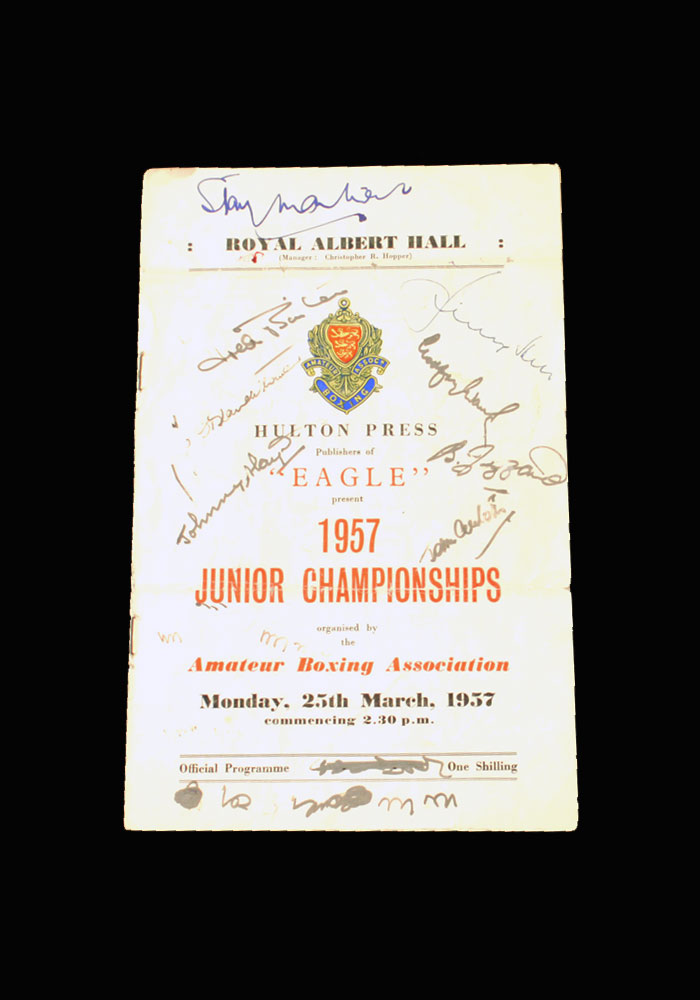
Stanley Matthews provides the connection between the two items in this small Blackpool 1956/57 collection. One relates to the Junior ABA Championship on 25 March 1957; the other is for Wanderers against a Stanley Matthews XI on 8 June. Together, they open a route into football memorabilia through an individual player’s public profile. The page’s interest lies in these particular occasions and the way Matthews’s name links them, bringing a boxing event and a separately assembled football team within the scope of a Blackpool collection.
The timing is significant. Matthews became the first winner of the Ballon d’Or in 1956 while playing for Blackpool, a club he had joined in 1947. That recognition gives a useful historical setting for material associated with him in the following year. It also explains why collectors may follow a player across several kinds of sporting publication. A club season can be represented through league fixtures, but it can equally prompt a more personal collecting strand built around the appearances, honours and named teams associated with one footballer.
The Junior ABA item is captioned “Stan gets an award”, making the recognition recorded by the collection part of its appeal. The caption does not identify the award, so its exact relationship to the boxing occasion remains a point for further research. The June programme offers a different starting point: the opposition is described as Wanderers, and Matthews’s team is identified by his name. That wording makes the match a distinct collecting subject. It encourages attention to the programme’s own team details and event description, which may help establish more about the occasion than the short catalogue entry alone.
These two objects work best when viewed together. The March item brings another sport into the story, while the June issue returns to football through a team named for Matthews. Their shared interest is the reach of a footballer’s reputation beyond the ordinary club fixture list. For a later collection centred on regular opponents, visit the Blackpool 1959/60 programmes. The contrast gives both pages a purpose: one follows a season through matches, while this pair preserves two specific occasions connected with a leading figure in Blackpool’s history.
-

Junior ABA Championship 25.03.1957 (Stan gets an award)
-
Wanderers v Stanley Matthews 11 08.06.1957