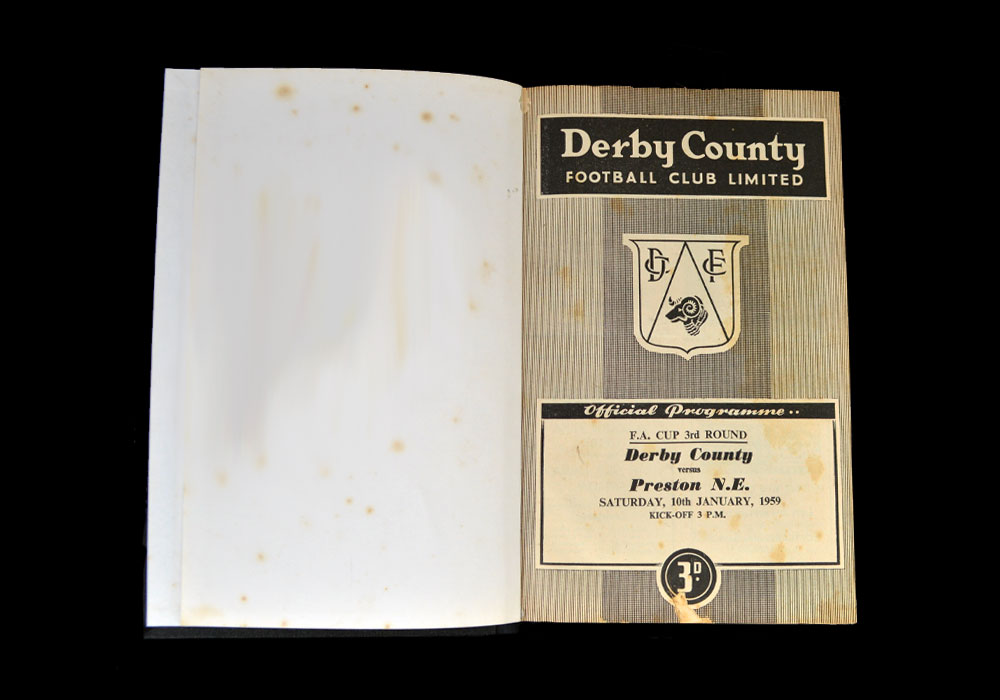
The 1958/59 archive brings together three different entries: a Derby County bound volume, Aldershot against Millwall and Plymouth Argyle against Accrington Stanley. It is a concise collection, but the objects open several routes into the season. The two match programmes preserve particular dates, while the bound volume represents a longer run of publications brought together. Each offers a different way of entering the same season. Their shared period also coincides with a change in the Football League’s lower divisions, as the former regional Third Divisions gave way to national Third and Fourth Divisions.
The Derby County volume is interesting as a collected object. Individual match programmes were produced for separate occasions, yet binding them together changes the way a season can be read and kept. A volume encourages comparisons across a sequence of issues, whether the interest is the fixture calendar, the club’s presentation or the details visible in the pages. It also offers a different starting point from a loose programme bought for one match, giving this small gallery a broader span than its number of entries might suggest.
Aldershot against Millwall is dated 27 September 1958, while Plymouth against Accrington belongs to March 1959. The Aldershot item carries a collection note referring to a fire at the printers, a detail worth examining alongside the scan itself. Plymouth’s programme falls within the campaign in which Argyle became champions of the new national Third Division. The two fixtures therefore connect the page with clubs experiencing the reshaped lower-league calendar, while remaining individual publications with their own dates, opponents and production histories.
For a closer view of the Argyle season, continue to the Plymouth 1958/59 programme collection, where the Accrington fixture appears among many other issues from the championship campaign. Returning to this page then places that club story beside a bound Derby volume and a different lower-league match. The comparison is useful for collectors deciding how to organise their own interests: by season, club, publication format or unusual production detail. Here, those approaches overlap within a compact selection, showing how even a handful of objects can connect football history with the history of the programmes themselves.
-

Derby County Bound Volume 1958/59
-
Aldershot v Millwall 27.09.1958 | Fire at Printers
-
Plymouth v Accrington 04.03.1959